Article updated on 21 November 2026.
A noise in the pipes when you turn on the tap most often comes from one of three causes: water pressure that is too high, poorly secured pipes that vibrate or knock (water hammer), or a tap part that is scaled up or worn (cartridge, aerator, valve, flexible hose). The type of noise (banging, whistling, vibration, squeaking) and where it occurs (a single tap or the whole house, hot or cold water) are generally enough to identify the cause. Most solutions are simple: pressure reducing valve, water hammer arrestor, pipe clips, descaling or replacing the cartridge.
In short
- Noise in the whole house: look at the pressure and the pipework.
- Noise on a single tap: the tap itself (aerator, cartridge, flexible hose, isolation valve) is the cause.
- Noise only on hot water: pipe expansion, the water heater or the hot side of the mixer.
- Banging when closing: water hammer. Whistling: water passage narrowed somewhere.
Noisy pipes when I turn on the tap: locating the source in 3 questions
Before taking anything apart, ask yourself these three questions. They rule out half of the possibilities.
- One tap or all of them? Open the sink, the basin and the shower in turn. If only one makes noise, the problem is localised to the tap or its connections. If all of them do, it comes from the system: pressure, pipe fixing, pressure reducing valve, water heater.
- Hot water, cold water or both? On a mixer, put the lever fully to the right (cold) then fully to the left (hot). A noise only on the hot side points towards pipe expansion, the water heater or the hot side of the cartridge.
- At what moment? On opening, while running, on closing, or only at half-open. A noise that disappears with the tap fully open almost always signals a narrowed passage that whistles or vibrates.
Diagnosis table: type of noise, probable cause, solution
| Type of noise | Probable cause | Solution |
|---|---|---|
| "Bang" or sharp knock when the tap is closed or when the washing machine stops filling | Water hammer: water stopped abruptly creates a pressure wave | Close the lever more gradually, fit a water hammer arrestor near the appliance, check the pressure |
| Pipes knocking in the wall or under the sink on opening | Poorly secured pipework moving under pressure | Add or tighten clips, wedge the pipes with an insulating sleeve |
| High-pitched whistle while running | Narrowed passage: isolation valve not fully open, scaled aerator, worn cartridge, blocked filter | Open the isolation valves fully, clean the aerator and filters, replace the cartridge |
| Whistling throughout the house | Pressure too high or faulty pressure reducing valve | Measure the pressure, fit or have the valve replaced |
| Vibration, humming, "foghorn" noise at half-open | Washer, valve or internal part vibrating in the flow | Replace the washer or cartridge, reduce the pressure |
| Creaking or "tick-tick" when hot water is opened | Pipes expanding and rubbing on a clip or a wall passage | Add a sleeve or lagging at the rubbing points |
| Gurgling, spluttering after a water cut | Air in the pipes | Open all the taps for a few minutes to purge |
| Squeaking when you operate the lever | Dry or scaled cartridge, handle friction | Clean and grease with silicone grease, or replace the cartridge |
| Noise on a new tap | Debris in the aerator or filters, kinked hose, isolation valve half closed | Clean aerator and filters, straighten the hose, open the isolation valve fully |
Water pressure too high: the number one cause of noise in the whole house
High pressure speeds up the water in the pipes: it whistles in narrow passages, makes the pipework vibrate and amplifies water hammer. It also wears out cartridges, flexible hoses and appliance seals faster.
Measuring the pressure
Buy a pressure gauge that screws onto an outside tap or onto the washing machine tap (20x27 thread). Close all the other water points, open the tap and read the value. In a home, you generally aim for a pressure of about 3 bar at the taps. Above that, a pressure reducing valve is recommended.
Fitting or adjusting a pressure reducing valve
The valve is fitted on the main supply, just after the meter, and is adjusted with a screw on top. If you already have one and the pressure stays too high, or if it whistles itself, it is probably scaled up or at the end of its life. The adjustment is within a DIYer's reach; fitting a valve on an existing installation requires turning off the main water and working on the pipe, which is more a job for a plumber if you are not equipped.
Water hammer: the bang when closing
When a moving column of water is stopped dead, the energy turns into a shock wave that makes the pipes bang. Single-lever mixers, which close in a fraction of a second, as well as the solenoid valves of the washing machine and dishwasher, are the usual triggers.
- Simple trick: close the lever over a second rather than with a sharp snap. If the banging disappears, the diagnosis is confirmed.
- Water hammer arrestor: this small shock absorber (air chamber or diaphragm) screws on as close as possible to the appliance causing the shock, for example between the tap and the washing machine inlet hose.
- Fixing: water hammer is all the noisier when the pipes are free to move. Check the clips under the sink, in the crawl space or the garage.
- Pressure: reducing the pressure mechanically reduces the violence of the shock.
Whistling tap: finding the narrowed passage
A whistle is almost always a sign that the water is passing through an opening that is too small. Check in this order, from the simplest to the most time-consuming.
- The isolation valves under the basin or sink. An isolation valve half closed, for example after some work, very often whistles. Open them fully.
- The aerator. Unscrew it at the end of the spout (size M22 or M24 on most taps, sometimes a concealed aerator removed with a specific key supplied). An aerator that is scaled or clogged with grains of sand narrows the water outlet. Soak it in white vinegar. Our guide on removing the tap aerator details how to do it.
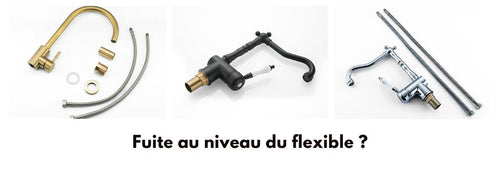
- The flexible hoses. A hose that is kinked, crushed against the cabinet or whose braid is deformed creates a restriction. The supply hoses of mixers screw into the body by an M10 end: if they are damaged, replace them, see how to change a mixer tap flexible hose.
- The cartridge. If the whistle changes with the lever position, the ceramic discs of the cartridge are probably scaled or worn. A descale may be enough; otherwise replace the cartridge (35 or 40 mm in diameter on most mixers, to be checked on the old part).
Thermostatic mixer or shower that whistles
On a thermostatic shower or bath mixer, whatever the make (Grohe, Hansgrohe, Jacob Delafon or other), the whistle most often comes from:
- partly blocked inlet filters, located in the eccentric fittings or at the inlet of the body;
- a scaled non-return valve vibrating in the flow;
- a scaled thermostatic cartridge, especially on the hot water side;
- a scaled shower head or shower hose, or a bath/shower diverter that no longer switches fully.
Turn off the water, remove the fittings to clean the filters and valves, then the cartridge if necessary. The full procedure is described in our article how to free a stuck thermostatic mixer. On a shower column, also think about the internal hose between the mixer and the overhead shower.
Mixer noise on hot water only
- Creaking on opening: hot water pipes expand as they warm up and rub in the clips or the passages through walls and floors. An insulating sleeve or a sheath at the rubbing point solves the problem when it is accessible.
- Whistling on the hot side only: scaled cartridge or filter on the hot side, where limescale builds up more.
- Noise coming from the water heater (whistling, bubbling): scaled safety valve unit or tank. Operate the safety valve unit according to the manufacturer's instructions; a water heater that "sings" or boils deserves a professional's opinion.
Squeaking tap or lever that squeals
A squeak when operating comes from friction between the handle and the cartridge, or from a cartridge lacking lubrication. Turn off the water, remove the handle (often a 2.5 or 3 mm Allen screw under a cover), then the cartridge by its clamping nut. Clean, apply a thin coat of silicone grease to the spindle and the seals, reassemble. If the squeak comes with a stiff lever, dripping or an inaccurate hot-cold mix, the cartridge is reaching the end of its life: see how to tell if the mixer cartridge is worn out.
New tap that makes noise
A tap that has just been installed and that whistles or vibrates is generally not faulty. The usual causes:
- building debris (hemp, swarf, sand) stuck in the aerator or in the hose filters;
- an isolation valve left partly closed after fitting;
- a hose twisted or bent to fit into the cabinet;
- a mixer not tightened properly on the basin or sink, which vibrates: retighten the fixing nut under the worktop;
- high water pressure that the old, more worn tap used to mask.
After fitting, it is also advisable to let the water run for a few minutes without the aerator to flush out impurities.
When should you call a plumber?
- The water hammer is violent and regular despite an arrestor: the fittings end up leaking.
- The measured pressure clearly exceeds the recommended value and there is no pressure reducing valve.
- The noise comes from inside a wall or a floor, with no accessible pipe.
- The water heater makes bubbling noises or the safety valve unit drips constantly.
Replace the tap rather than repair it?
If the cartridge cannot be found, if the tap body is scaled up inside or if the tap combines noise, a leak and a stiff lever, replacement is often more sensible. A well-installed ceramic cartridge mixer, on a correct pressure, is silent. You will find our models for the kitchen, the basin and the shower, as well as thermostatic shower mixers.
Frequently asked questions
Why do the pipes make noise when you turn on the tap?
On opening, the water suddenly starts moving again: if the pressure is high or the pipes are not well secured, they vibrate or knock. On hot water, the expansion of the pipes as they warm up adds creaking.
Why does my tap make a noise when the water runs?
A continuous noise while running is most often a whistle or vibration caused by a narrowed passage: scaled aerator, isolation valve not fully open, worn cartridge or kinked hose.
My tap only makes noise at half-open, is it serious?
No, but it is a sign of wear: an internal part (washer, valve, cartridge disc) is vibrating in the flow. Descale the cartridge; if the noise persists, replace it.
Is a water hammer arrestor enough to get rid of water hammer?
It reduces it considerably if it is placed near the appliance causing it. If the pressure is very high or the pipes are poorly secured, those causes need dealing with too.
My shower makes noise, but not the other taps: what should I check?
Start with the shower head and the shower hose (limescale), then the mixer's filters and valves, and finally the thermostatic cartridge or the diverter.
Can water pressure damage a mixer tap?
Pressure that is too high speeds up the wear of cartridges, flexible hoses and seals, and makes water hammer more violent. A pressure reducing valve protects the whole installation, including the washing machine and the water heater.